When Rachel gave me a record player for Christmas, she included with it an album of Big Band recordings because she knew that what I primarily wanted out of a record player was the romance of playing this music on it.

There’s a reason for that. When we were first married, our Sunday night after-church ritual was to eat fast food with friends. (The iron-clad digestive system of youth…) But we had to keep an eye on the time because we needed to leave in time to catch “Big Band Jump,” a syndicated radio show on our local AM station which we would listen to on the drive home and while we got ready for bed. Then once we were in bed we would listen to an old-time radio show performing all sorts of mystery and thriller stories. (I can’t remember its name - maybe it was rebroadcasts of CBS Radio Mystery Theater?)

While that story makes it sound like we were married in 1948 instead of 1998, it’s one of my fondest memories of those early days of our marriage. Big Band music already has a certain romance to it, but add to that two newlyweds in a small apartment listening to music and stories from their grandparent’s time and you have a sonic impression that lasts.


Started reading Four Thousand Weeks by Oliver Burkeman. 📚 Quoting Seneca, Charles Eisenstein, and Marilynne Robinson all in the introduction? He’s singing my song.


Alan Jacobs has recently posted about his news consumption habits in response to a worthwhile piece by Oliver Burkeman. Taking the latter first, Burkeman says that while there has always been alarming news, “the central place the news has come to occupy in many people’s psychological worlds is certainly novel”. Is this a healthy state of affairs?

Assuming you’re not reading this in an active war zone, it doesn’t follow that you need to mentally inhabit those stories, all day long. It doesn’t make you a better person – and it doesn’t make life any easier for Ukrainian refugees – to spend hour upon hour marinating in precisely those narratives over which you can exert the least influence.

What approach is preferable to marinating in the news? He discusses and dismisses both the “renunciation” and “self-care” approaches. Instead, he says, we should “adjust our default state”. Dip into and out of the news. Take action where you can and then move on. Then guard this practice with some “not-too-rigid” personal rules for handling the information. Rather than marinating in the news, do the good you’re actually capable of: “meaningful work, keeping your community functioning, being a good-enough parent or a decent friend”.

Burkeman’s rules involve putting physical distance between himself and his laptop and phone, along with time limits for their use. Jacobs describes his practices in his blog post:

  1. “Most important: I avoid social media altogether.
  2. I always have plenty to read because of all the cool sites I subscribe to via RSS, but not one of those sites covers the news.
  3. I get most of my news from The Economist, which I read when it arrives on my doorstep each week.
  4. In times of stress, such as the current moment, I start the day by reading The Economist’s daily briefing.”

I second Jacobs’ recommendation of RSS feeds. I use NetNewsWire and it really is a good way to keep track of writers and sites you’re interested in. Whenever something new is posted, it simply appears in the app and I can read it whenever it is convenient for me.

I also second his recommendation of avoiding social media. I’ve written before (and likely will again) about my discovery, once I closed the accounts, of how much my thoughts were driven by the timeline, not my own interests.

I avoid cable news at all costs. I believe it is, just as much as social media, engineered to hijack your brain. #CNNsucks

I tend to pick up most news through something like ambient awareness. If something is big enough, I usually hear about it one way or another. In times when I feel like I need to attend to the news (as in recent days), I typically go to the BBC news site because

  1. They have a reputation for being reliable and professional, and
  2. I don’t constantly hit paywalls, like at the NYT or WaPo, and
  3. It’s not jammed with video and ads. Again, #CNNsucks.

For me, it is an essential practice (and Burkeman refers to this) to continually distinguish between what I can and cannot control. I have little to no control over much of the awful shit that happens in the world. There are a few practical actions I can take. Beyond that, though, my responsibility is to learn (both for myself and with my family and friends) how best to navigate and understand the world we find ourselves in. It is useful to remember that, if life is the Battle of New York, I am not Thor or Captain America or even Hawkeye. I’m not even the NYPD. I am one of those people in the background scrambling to avoid falling debris.


That there is a fun ride.


Purge me with hyssop, and I shall be clean: wash me, and I shall be whiter than snow. (Psalm 51:7)

Wherever there is a confrontation with evil, there is a desire to be free from it. The evil must be destroyed - but if it can’t be destroyed, it must be beaten back. And if it can’t be beaten back, then at least we must be personally free from it.

I was born into a group of Christian churches that were either a cult or had cultish tendencies, depending on which individual church you attended. Their singular obsession was purity. Their watchword was ”come out from among them, and be ye separate, saith the Lord, and touch not the unclean thing” (2 Corinthians 6:17). They wanted bright lines of separation from “the world” and its ways; nothing was to be left up to judgment. Women’s skirts must be below the knee. Women’s hair must not to be cut or even trimmed. No makeup. No jewelry. Men’s hair must be short and kept at the natural hairline. No television. In my final months in those churches, I challenged my pastor by saying some of the rules seemed so arbitrary. He replied, “Sometimes the lines are arbitrary, but they must be maintained.”

The Holiness people believed they were surrounded by evil on all sides, every person a possible agent provocateur. They rejected the world around them - including what amounted to all Christian churches - as corrupt and dangerous. They were, in a sense, a protest movement. Protest movements, if they do not mature, often end up as funhouse mirrors of what they oppose. They become attached to their enemies, defining themselves in terms of the opposition.

My twenty-seven years among the Holiness people made me sensitive to the psychological need for purity. Over the years I’ve seen this pattern repeat in activist groups. Because they define themselves by their opposition, they become anxious to eliminate any commonality with their opposite. Their relative positions grow further apart as they eliminate any middle ground. They engage in ideological and personal purges. Purity becomes the goal as they continue to identify themselves in terms of the hated other.

This is not an argument in favor of moderation. The truth does not inevitably reside in the middle. I have opinions that people in the so-called moderate middle would call extreme. What I hope to avoid, though, are opinions that are driven solely by opposition to an “other”, in pursuit of purity.

Because purity is not possible. Especially not in a world as interconnected as ours. In a sense, we have always been interconnected. It has always been true that conflict and oppression reduces the victor as well as the victim. The modern world, however, has made those connections more tangible and obvious.

Refusing to buy from Amazon because you want to avoid complicity with their terrible practices (personal purity) will not work because, if you use the internet, you’re using Amazon Web Services in one way or another since they provide the infrastructure for so, so many websites. Believing you are innocent of global ecosystem destruction and carbon pollution because you recycle and buy “green” products is a delusion. Examples could be multiplied.

The Amish are more complicated than some people think. There is a common belief that their antique way of living is about avoiding the modern world, i.e., maintaining purity. But their decisions to avoid certain technologies are more nuanced than that. The decisions they make are made on the basis of community values, not simply in opposition to the modern world. (Undoubtedly this process itself is not always pure in reality, but this is the way they describe themselves. And it seems to be borne out in many cases.) I’ve seen them make decisions that make no sense if they are in service to purity, but do make sense if they are defined in terms of, for example, maintaining community cohesion.

Give up on purity. Not only is it a goal driven by anxious attachment, it is not achievable. But if purity is not our goal, what could be? I would say that one healthier, more achievable goal is to avoid servitude. If we cannot achieve pure sovereignty over our lives, we can at least maintain some agency directed in terms of our values. I am off social media - but I did not close the accounts because I wanted to be pure. I closed them because my mind was being colonized. My mental energy was being spent on whatever was the timeline’s momentary obsession. Leaving social media has meant that my thoughts are much more directed by my own interests and goals.

What are your values? How can you shape your life in accordance with your values? These are the questions that should occupy our minds. The answers will allow you to build a life for something.
🎵 “I had a thought about darkness; a thought’s just a passing train.” - John Moreland 🎵


Craig Mod:

Boredom is everything, man. I think our loss of boredom in contemporary society is one of the greatest, weirdest, ambient losses. It is one of these things that’s hard to quantify the value of. And we’ve lost it so completely and totally that we very rarely have moments to even re-experience it, unless you do so intentionally. And so for me, yeah the boredom of these walks is, I would say, 50% of the value of it. It’s forcing yourself into a place where you’re not teleporting mentally.


“Go to the Limits of Your Longing” by Rainer Maria Rilke

Translated by Joanna Macy Listen God speaks to each of us as he makes us, then walks with us silently out of the night. These are the words we dimly hear: You, sent out beyond your recall, go to the limits of your longing. Embody me. Flare up like a flame and make big shadows I can move in. Let everything happen to you: beauty and terror. Just keep going. No feeling is final.

Continue reading →


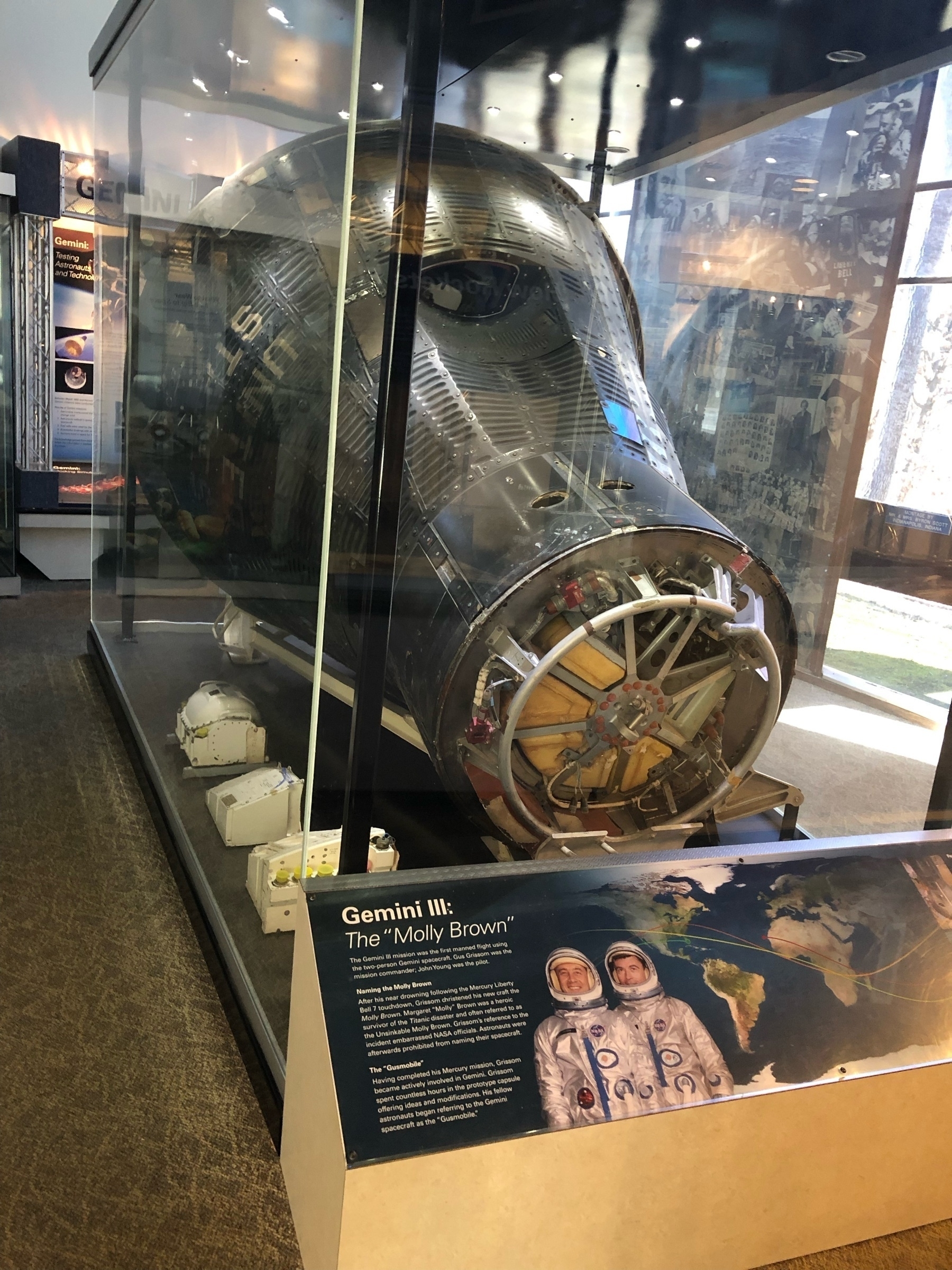
Stopped in at the Gus Grissom Memorial at Spring Mill State Park today. He was the second American in space and died tragically in a fire aboard Apollo 1 during pre-flight testing.


When God placed Adam and Eve in the Garden of Eden, he gave them a command and warning: do not eat from the tree of the knowledge of good and evil, lest you die. They broke that commandment and were cast out of the place of perfect harmony and cursed with pain.

This, I would argue, is the mythological rendering of human self-consciousness. God wanted to prevent Adam and Eve from the knowledge of good and evil, a discriminatory knowledge that separates into subject and object. The tempting serpent correctly predicted “in the day ye eat thereof, then your eyes shall be opened, and ye shall be as gods, knowing good and evil.” They ate, saw that they were naked, and hid from God; that is, they became self-conscious.

This is the fundamental break from the more-than-human world. Somewhere in the deep past we became aware that we related to the world in a way that was unique and that created distance from the creatures around us. The cherubim crossed their flaming swords; there was no going back.

We continued in this break for ages upon ages. Some of us sought to understand and heal it through philosophy and religion. So often, though, these attempts to understand and heal only deepened the break by moving the promised healing into some future existence when the self is united with the divine or subsumed into the cosmos.

Meanwhile, technology increasingly replaced manual labor and freed our minds to develop and store knowledge. Now, in our time, the wealthy (by global standards) have almost no contact with the natural world. They have become knowledge workers, service workers, etc., who buy packaged and processed food in grocery stores.

Our ancestral memory points to a time when we broke from the more-than-human world. In the time since, we have drifted further and further away. Self-consciousness, the awareness that we are separate, has led to the abstraction of our lives. We live by ideas: nations, democracy, money, freedom, morality, and many more. We argue over ideas. We divide families over ideas. Ideas threaten to ruin our common life.

We have an epidemic of anxiety and depression because ideas are insufficient as a substrate for human life. We have multiple ecological crises because self-consciousness has unmoored us from the source of our lives. The head drifts free of the body and is sickened.

What is the solution? I don’t know. Solutions are just more ideas. “The Way that can be told is not the true Way.”