Posts in: robinson-jeffers

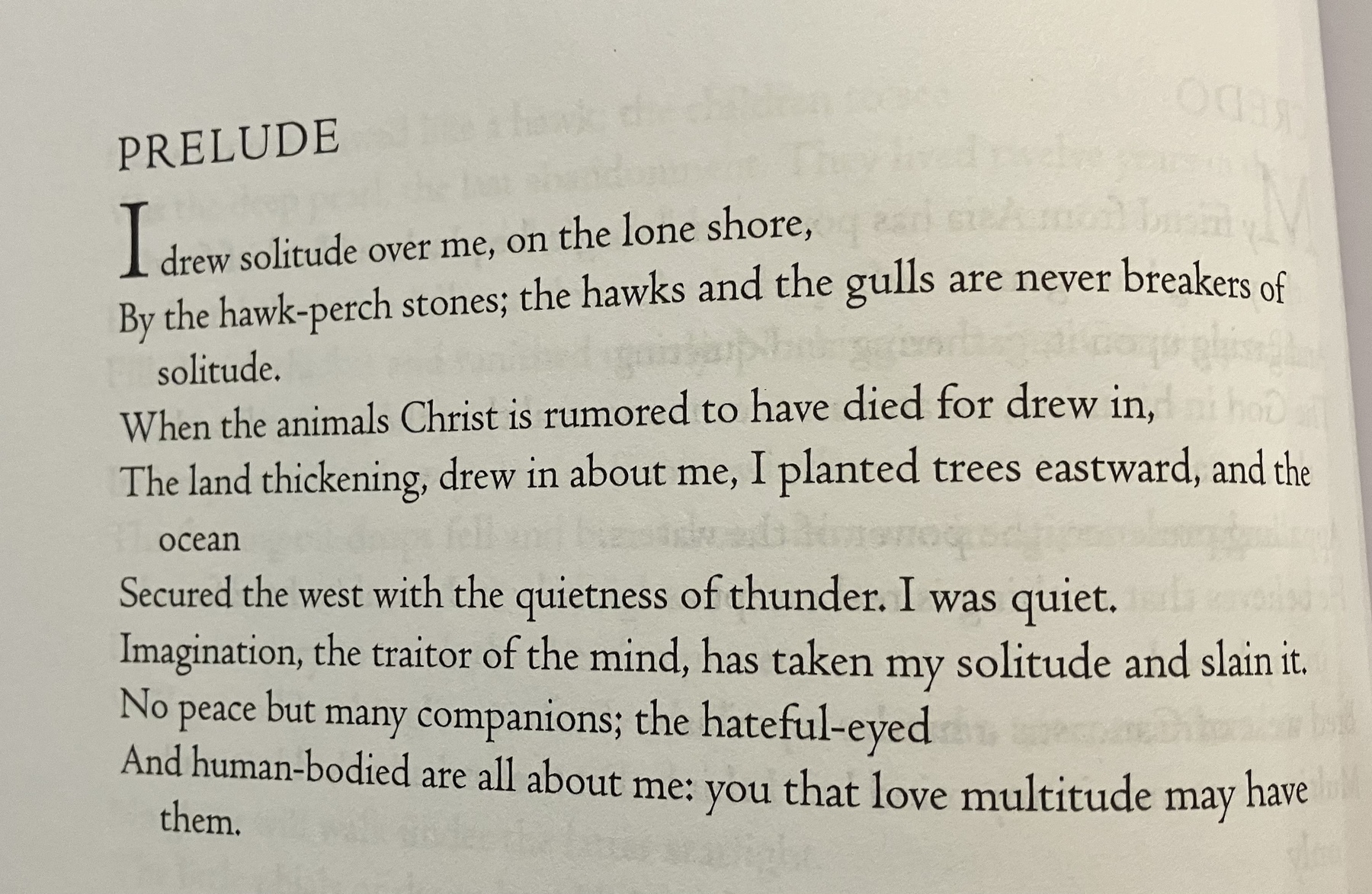
My responsibility in a full cosmos

Robinson Jeffers: As for us: We must uncenter our minds from ourselves; We must unhumanize our views a little, and become confident As the rock and ocean that we were made from. How does living in a full cosmos affect my daily life? As dear old Robinson says, it unhumanizes my views a little; it de-centers me. In an empty cosmos, humans alone have agency. Humans can be acted upon by impersonal forces, certainly, but those actions are definitionally meaningless.

Continue reading →


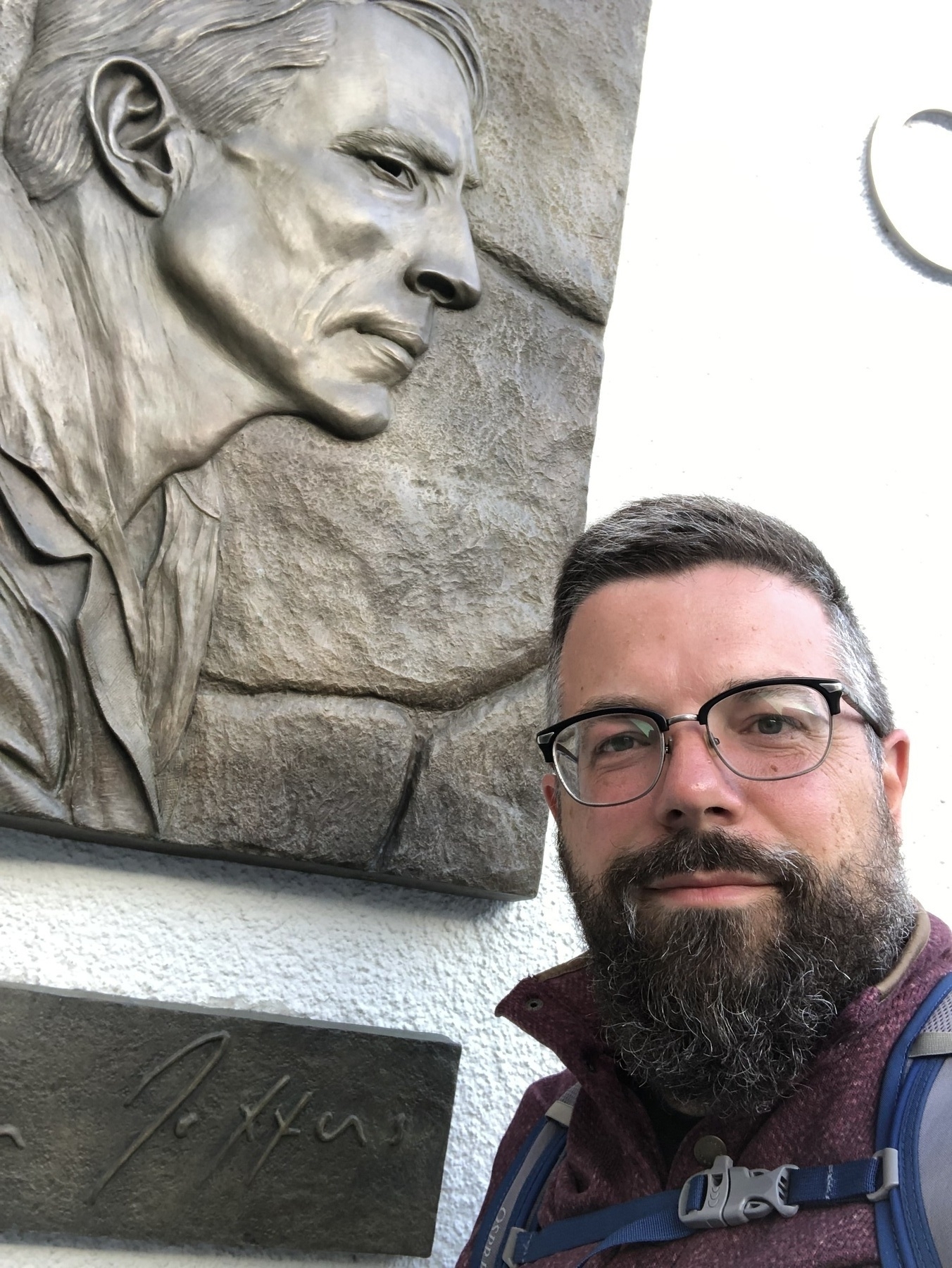
Happy birthday to Robinson Jeffers (1887-1962), “inhumanist” poet of the central California coast. In one of the highlights of 2022 and possibly my life, we visited Tor House and Hawk Tower and got a personal tour. They ask visitors not to post any interior photos, so here I am standing outside the gate while we awaited our guide.
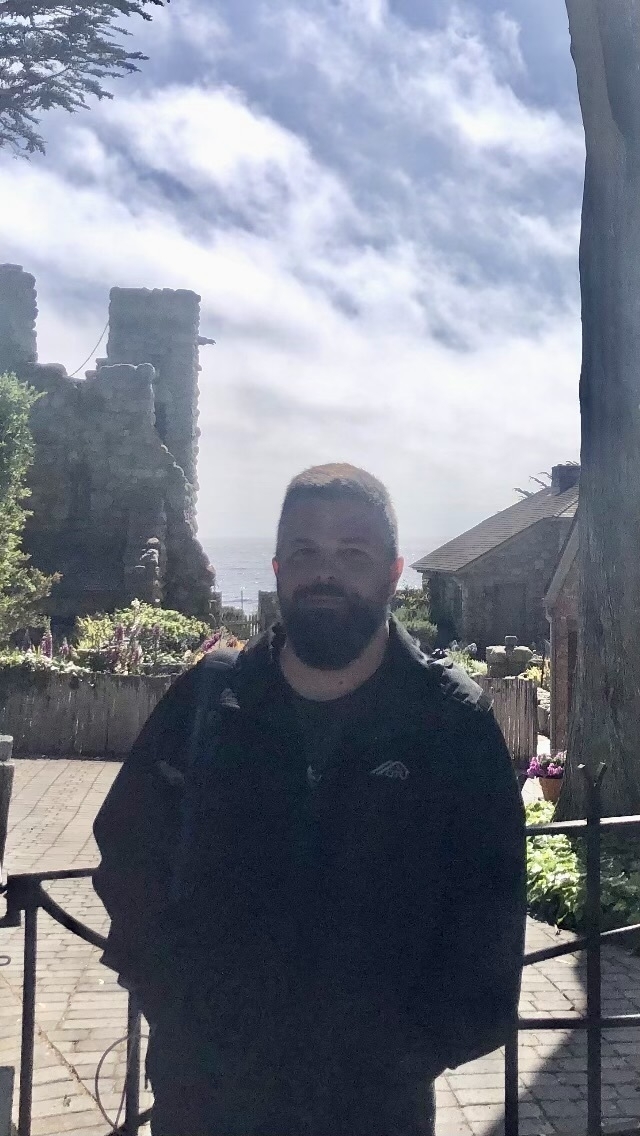
Auto-generated description: A bearded individual is standing in a sunlit outdoor setting with stone ruins and greenery in the background.

I have three birthdays of people unrelated to me on my calendar: Wendell Berry, J.R.R. Tolkien, and Robinson Jeffers. They are there because each writer’s unique vision has formed me in important ways.

If Wendell Berry is my icon for the close, domestic, and dear, then Robinson Jeffers is my icon for wild and indifferent nature. He is medicine for our innate, human egocentrism. He called his outlook “inhumanism” and described it like this:

It is based on a recognition of the astonishing beauty of things and their living wholeness, and on a rational acceptance of the fact that mankind is neither central nor important in the universe; our vices and blazing crimes are as insignificant as our happiness. We know this, of course, but it does not appear that any previous one of the ten thousand religions and philosophies have realized it. An infant feels himself to be central and of primary importance; an adult knows better; it seems time that the human race attained to an adult habit of thought in this regard. This attitude is neither misanthropic nor pessimist nor irreligious, though two or three people have said so, and may again; but it involves a certain detachment.

…

To sum up the matter:–“Love one another” is a high commandment, but it polarizes the mind; love on the surface implies hate in the depth,–(Dante who hated well because he loved)–as the history of Christendom bitterly proves. “Love one another” ought to be balanced, at least, by a colder saying,–this too a counsel of perfection, i.e., a direction-giver, a guide though it cannot be a rule,–“Turn away from each other,"–to that great presence of which humanity is only a squirming particle. To persons of Christian faith, if any should read this, I would point out that Jesus himself, intuitive master of psychology, invoked this balance. “Love your neighbor as yourself”–that is, not excessively, if you are adult and normal–but “God with all your heart, mind and soul.” Turn outward from each other, so far as need and kindness permit, to the vast life and inexhaustible beauty beyond humanity.

Our lives are so taken up with ourselves. We spends hours of each day talking to each other, watching and dreaming about each other. Jeffers, though, sitting atop his pile of sea-washed granite overlooking the Pacific, writes of hawks and storms and takes a long view of history. Reality is out there, beautiful and pitiless.

Credo
My friend from Asia has powers and magic, he plucks a blue leaf from the young blue-gum
And gazing upon it, gathering and quieting
The God in his mind, creates an ocean more real than the ocean, the salt, the actual
Appalling presence, the power of the waters.
He believes that nothing is real except as we make it. I humbler have found in my blood
Bred west of Caucasus a harder mysticism.
Multitude stands in my mind but I think that the ocean in the bone vault is only
The bone vault’s ocean; out there is the ocean’s;
The water is the water, the cliff is the rock, come shocks and flashes of reality. The mind
Passes, the eye closes, the spirit is a passage;
The beauty of things was born before eyes and sufficient to itself, the heart-breaking beauty
Will remain when there is no heart to break for it.
Auto-generated description: A grassy field is bordered by a line of trees with autumn foliage under a partly cloudy sky.

The Excesses of God
Robinson Jeffers

Is it not by his high superfluousness we know
Our God? For to equal a need
Is natural, animal, mineral: but to fling
Rainbows over the rain
And beauty above the moon, and secret rainbows
On the domes of deep sea-shells,
And make the necessary embrace of breeding
Beautiful also as fire,
Not even the weeds to multiply without blossom
Nor the birds without music:
There is the great humaneness at the heart of things,
The extravagant kindness, the fountain
Humanity can understand, and would flow likewise
If power and desire were perch-mates.


I was glad to read this bit from Bill McKibben in his tribute to Wendell Berry:

I’m lucky that I was reading Ed Abbey at the same charged moment, because that helped me love the wild as fully as the pastoral, and the irreverent as fully as the good.

I’ve often considered the same contrast, but with Berry and Robinson Jeffers. Berry a poet of the domestic; marriage and community are some of his most common themes. Jeffers is a poet of the wild; hawks and granite and the roar of the Pacific are everywhere in his work.

Having read quite a bit of both of them, I cannot imagine them anywhere other than where they are. Wendell Berry writing and working his farm, considering the soil along the Kentucky River. Jeffers looking out over the Pacific as it washes over the granite cliffs. They are the two most “placed” writers I’ve ever encountered. Some day when I have more time, I’d like to write more about this, with specific examples from their work.


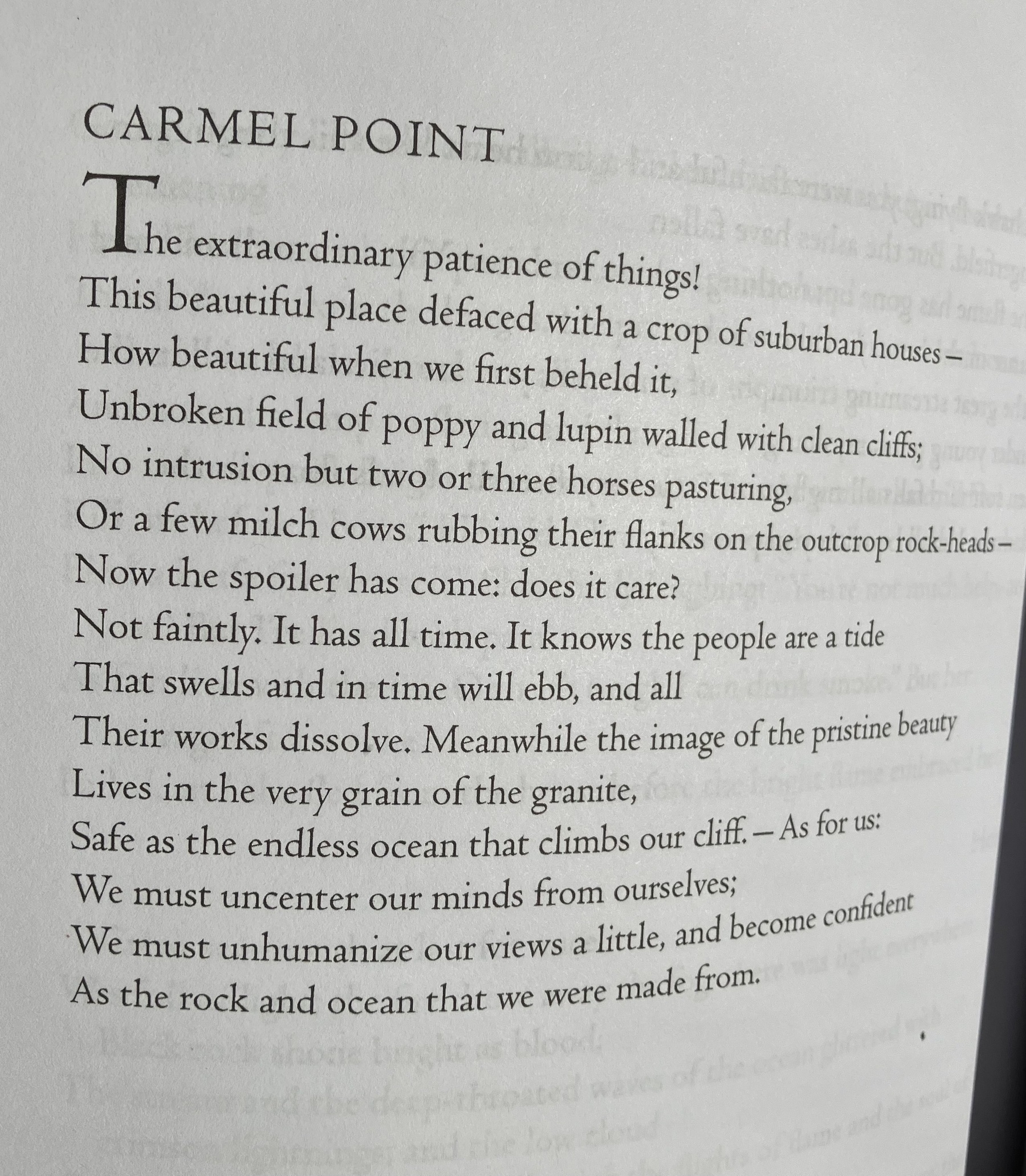
The opening line of “Carmel Point” by Robinson Jeffers has been on my mind recently: “The extraordinary patience of things!”

Dear old Robin can be crotchety. In fact, he can be downright misanthropic. I sympathize.

But his vision was framed by what we’d now call deep time. Within this frame, human affairs seemed frivolous, and humanity evanescent. He’s been described as a nature poet. I’d call him Gaian. He doesn’t merely appreciate landscapes; he perceives the intelligence of the cosmos.

In “Carmel Point”, he describes Gaia as an unhurried, indifferent observer of frenetic human building. She knows all these housing developments will soon enough crumble into the sea.

If we adopt a similarly long view, he says, we will find our confidence. Anxiety is everywhere because confidence is gone and confidence is gone because we have become locked into the short term. We cannot see into the future.

To be fair, the short term is gloomy. And, furthermore, we may go extinct at any point. But what does that matter, really? We are at the service of life, for whatever time life grants us. Life will continue, in one form or another, for many aeons to come. This is enough.


Following up on my previous post, it’s worth noting that he regards this as a counsel of perfection on the order of “love one another”, that is to say, ideals to be striven after even if never fully attained. Counsels of perfection, of course, bring monastic vows to mind. A lot to think about here.


The heart of Jeffers’ Inhumanist philosophy is the turn away from the human, toward the nonhuman. A shift in the locus of value and attention. From his preface to Double Axe:

Turn outward from each other, so far as need and kindness permit, to the vast life and inexhaustible beauty beyond humanity. This is not a slight matter, but an essential condition of freedom, and of moral and vital sanity.


Never has anyone complained about the neighbors so beautifully. (This is Jeffers, if you couldn’t guess.)