jabel
About Email newsletter Sanity Project Wendell Berry Resources Page Archive Also on Micro.blog
  • This morning I heard a bit from The Wayfinders by Wade Davis, a book about the Polynesian open ocean navigators. Astonishing. Not only the volume of knowledge required to do such navigation, but the types of information used–observations in minute detail gathered over centuries–is amazing.

    → 7:49 AM, Oct 8
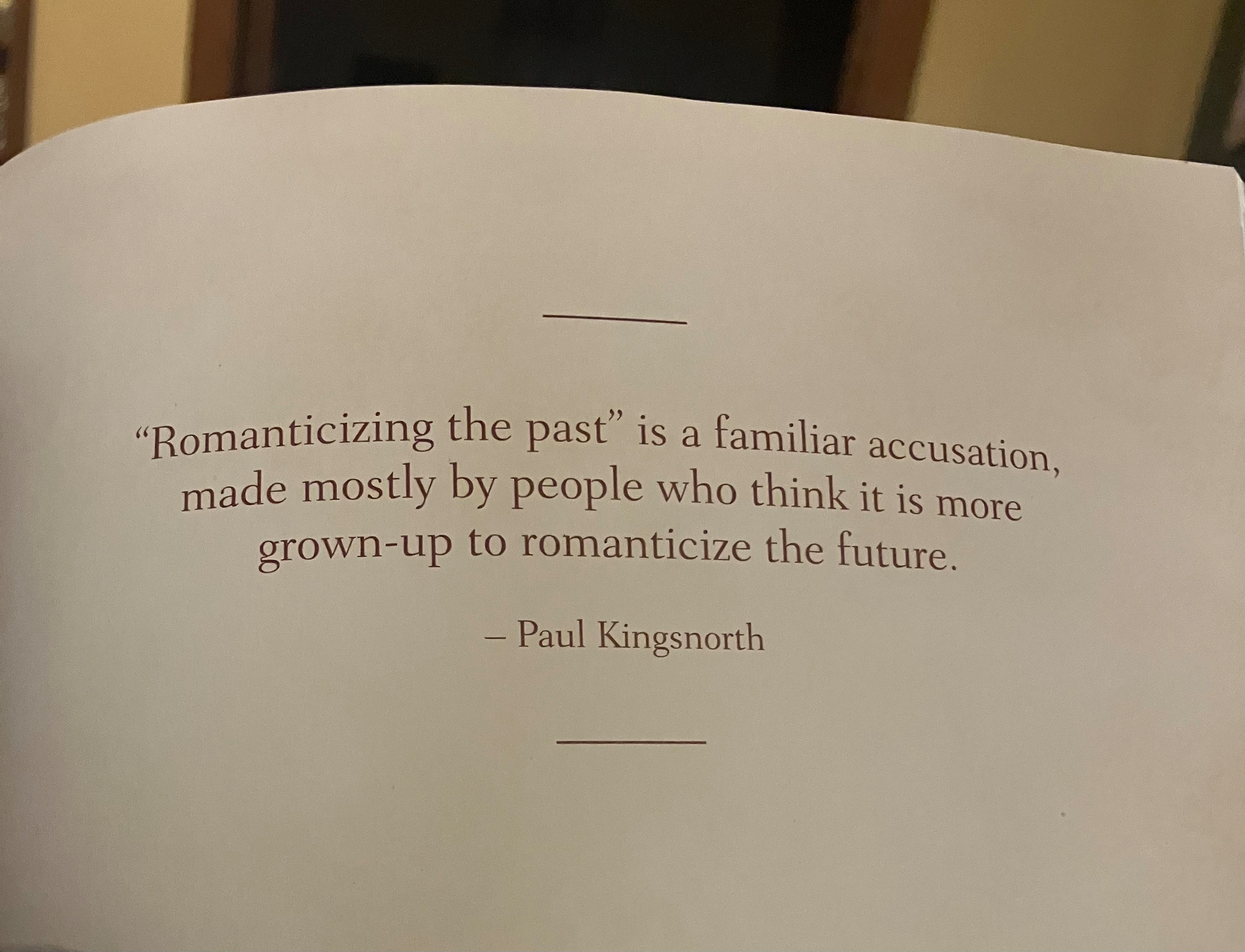
  • To all the folks complaining about how popular Halloween is among adults today, I offered this as my considered reply:

    → 11:25 AM, Oct 7
  • This is a good list of ideas for cleaning up your garden at the end of the growing season while also keeping the well-being of your local critters in mind.

    → 7:46 AM, Oct 7
  • Thinking about the research I did yesterday, what will future researchers do, given the demise of local newspapers? Even the silly society pages gave me valuable information. Now such things are on social media sites, behind subscriptions, with terrible search capabilities.

    → 6:15 AM, Oct 6
  • Rachel and I are continuing to research the lives of our ancestors of place. Today we looked into the Schroer family, who were the second family to live here (1939-1971). Dr. William Schroer was a chiropractor who moved to Bedford from Poland, Indiana, in 1927 to open a practice. He and his wife Delzena had one daughter Florine.

    Dr. Schroer was a deacon of First Presbyterian here in Bedford. The family seem to have been socialites: very active in various clubs and committees. Dr. Schroer was a Mason and his daughter was a member of the Order of the Eastern Star.

    We also visited their graves in Poland, Indiana, a little over an hour from here. They seem to have had deep roots in that little community, which was heavily populated with German immigrants.

    This is just a sketch for the moment. I plan to write a more complete history of the house after I gather more information. Rachel and I were saying today that we have thought so much about our house and its history and people that it’s beginning to feel like a person in itself.

    Young Schroers: Auto-generated description: A vintage photograph features a man and a woman in formal attire, posing in front of an ornate backdrop.

    Older Schroers: Auto-generated description: A newspaper clipping features a photo of an older couple, Dr. and Mrs. Schroer, along with a caption detailing their wedding anniversary celebration.

    → 6:29 PM, Oct 5
  • Rachel continues to do great work on the floors. The living room is now done; we can start moving furniture back in by Monday. The floor is pine, which is notorious for rough grain and not taking stain evenly. Some people say it’s a mistake to stain pine but I think it looks great. Another thing about pine: it turns orange as it ages. In our case that means our stain—Minwax “early American” which is brown—actually ended up looking more red. Two coats of polyurethane as a finish.

    → 11:41 AM, Oct 4
  • Had breakfast with the distinguished author today.

    → 8:47 AM, Oct 4
  • Gave blood today at a drive across the street. Thanks to @JohnBrady for posting that one article that one time that encouraged me to set up the appointment. I’d link it but I can’t find it now because of his sand mandala blogging model. 😂

    → 1:17 PM, Oct 3
  • I hope you’ve had the experience of listening to someone recall people and places as you pass through the countryside. I also hope you were not bored or impatient with the experience–because you were experiencing the conjuring of a living landscape through the magic of memory.

    For all of our society’s embrace of a mobile workforce, its stereotyping of those who never move away from their hometown, and its elevation of travel to the sacramental, there are certain experiences only available to those who have settled into a place long-term. One such is the perception of a landscape spread across space and time. Beautiful places become such through the infusion of a place with the awe and gratitude of a thousand generations. Houses become projects undertaken by hands that never shook in greeting but meet in the intimacy of shared work. Maybe we have ceased to believe in an enspirited universe because we so rarely remain in a place long enough to meet the neighbors.

    → 8:11 PM, Oct 2
  • When we first began our garden in 2020, we intended it not only as a collection of pretty flowers and vegetables but as a flourishing habitat. One of the keystones of that habitat is our tiny wildlife pond. We were amazed at how quickly life starting showing up in it; even larger critters started drinking from it regularly.

    This is Morty. He’s a raggedy neighborhood cat who first showed up last winter to drink from our pond. He disappeared by the spring and then returned a few weeks ago, again to drink from the pond during the late summer drought. This time, though, he seems to have decided to stay.  

    Rachel was the first to notice that he is blind in one eye and hard of hearing. That combined with his shagginess makes us think he’s pretty old. After he started showing up every day and laying by the pond, Rachel named him Morty and started feeding him. While he never lets us get near him, he has stopped running every time we go outside.

    He’s almost always by the pond, either napping or watching whatever is going on in it. At first we were concerned he would kill a bird, but he doesn’t seem to have enough energy for that.

    Our garden is only peaceful if you’re an apex predator—but that cycle of life and death is part of the deal when you’re trying to build a flourishing habitat. I’m glad Morty is spending some part of that cycle in our backyard.

    → 4:04 PM, Oct 2
  • We’re finished with the floors for today. Now I’m sitting here in this upset of furniture waiting on Rachel and Darcy. There’s the most delicious breeze, stirring the wind chimes into a sound like singing bowls. All originating in a ferocious, deadly hurricane 750 miles south of here.

    → 12:40 PM, Sep 28
  • Two rooms ready for sanding. Both have a rectangular section in the middle with an older finish. Like something semi-permanent was there at one time and someone finished the floor around it. A mystery. Also, we’ll replace that plywood patch by the window with some good flooring cut from a closet.

    → 11:56 AM, Sep 28
  • You never know what you’ll find when you pull up the carpet on a 114 year old house. Someone covered a hole with a peanut lid. We plan to leave it; the bookshelves will cover it anyway.

    → 7:35 AM, Sep 28
  • We’re pulling out the carpet in the front half of the house today. In every project Rachel and I have worked on she has three essential tools: needle nosed pliers, a crowbar, and a butter knife. If it can’t be done with one of those three, she says, it doesn’t need to be done.

    → 7:12 AM, Sep 28
  • Rachel is repainting the front half of our house. All the books (plus some records and CDs) had to be moved to the dining room. Quite a pile! I’ll be taking this opportunity to thin the collection and rearrange them before reshelving when the project is done.

    → 9:49 AM, Sep 27
  • The Given Life, part 1

    My wife and I left the Holiness churches at the beginning of 2004 and joined the Lutheran Church-Missouri Synod (LCMS). I was already a heavy reader of theology at that time (both books and blogs), which is partly why we left Holiness. Once I no longer had to hide my growing and serious disagreements with the churches of my childhood, I started my own blog. My first post was an explanation of why I left Holiness. The post was titled “The Given Life” after the Wendell Berry poem. I’ve thought about reproducing it on this blog but it’s so badly written that I can’t bear it. While I’m not a great writer now, I was much worse then.

    Ten years after that I wrote an essay cleverly entitled “Ten Years Out of Fundamentalism.” That one is a bit less embarrassing.

    Since this is the twentieth year since we left, I’ve often thought over the last few months of writing a new version of the essay but never got started. So rather than trying to write a single, long piece, I’ve decided to make it easy on myself and write a series of shorter posts, which I’ll gather under a category “The Given Life”, named after that first essay.

    First, who are the Holiness people?

    I’ll tell you now: you’ve never heard of them. You may think you have but you’re very likely wrong. Not only are they an obscure branch of fundamentalist Christianity, they’re fiercely independent and don’t have a single denominational identifier. Say what you will about the alphabet soup of Christian denominations; at least they’re identifiable.

    The Holiness people are a group of independent, traditional Pentecostal Holiness churches.

    • Independent: Each church is self-governing, though there are loose affiliations or “fellowships” around the country created for the purposes of supporting each other and, often, organizing campmeetings. The pastor rules each church–which is why I’ve said before that each individual church can range from “merely” fundamentalist to cultish. I’ve been a member of churches all along that spectrum. As for their opinion of other Christians, the Holiness people believe they are pretty much the only ones going to Heaven. There are a couple of other (also rather obscure) groups that might be okay but that’s it.
    • Traditional Pentecostal: They are not Charismatic or Word-Faith or Assembly of God or any of those folks you see on Christian TV. In fact, they loathe those people. The Holiness people believe in healing, yes, but not in the “name it and claim it” sense; for them, healing is a real but rare thing to be sought but not demanded. They also believe in ecstatic worship and speaking in tongues. Not learned tongues, mind you. That is one of the things they loathe about the TV Pentecostals: they “taught” people how to speak in tongues. For the Holiness people, speaking in tongues is a spontaneous act of the Holy Ghost speaking through a person. When they dance in the Spirit, it is not a choreographed, practiced step but a wild paroxysm. Though they would reject this framing, the Holiness people believe in worship that could be characterized as shamanistic. They utterly reject the “respectable” or the “formal.”
    • Holiness: For the Holiness people, Christianity fell almost entirely into formalism and apostasy sometime in or after the apostolic age and did not recover until around the time of John Wesley or, at latest, the Azusa Street revival. Some Holiness people believe in a “second work of grace” experience of sanctification like the Wesleyans. Mostly, though, the “holiness” in Holiness people is less about a doctrine of sanctification than it is about “standards”, i.e, rules of dress and behavior. An incomplete list: women must have long, untrimmed hair; men’s hair must be cut at the natural hairline and no facial hair; women’s must wear dresses or skirts that are knee length; no makeup; no shorts or jewelry for anyone (some made an exception for wedding rings); no television or movies; no secular music; no Christian rock or pop music. The list really could go on for a while. Also, to be clear, these were not considered “house rules” but the very commandments of God. To violate these standards was to sin.

    I should note that I’m explaining the Holiness people as they were when I was among them 20+ years ago. I suspect, based on what I see of them today, that they are not quite so strict as they used to be.

    I think that will serve as a decent introduction to the Holiness people. Feel free to add comments or questions, and if anything significant comes up I may edit this post to include it. The next post will shift to my experience in the Holiness churches.

    → 3:55 PM, Sep 26
  • We are five days from “pencils down” on the audit. It’s been a tough one. No problems, just a lot lot lot of detailed questions and follow-ups. My plan is to have a few four day weeks followed by a week off in October. Then we replace our general ledger about a month from now. Shew.

    → 8:19 AM, Sep 25
  • I won’t pretend that I have a sophisticated understanding of AI or a nuanced idea of where and how it can be safely used. I do, however, have some principles that will guide my own personal approach to the technology. And, unsurprisingly, they can be found in a passage from Wendell Berry (from Life is a Miracle):

    And so I would like to be as plain as possible. What I am against–and without a minute’s hesitation or apology–is our slovenly willingness to allow machines and the idea of the machine to prescribe the terms and conditions of the lives of creatures, which we have allowed increasingly for the last two centuries, and are still allowing, at an incalculable cost to other creatures and to ourselves. If we state the problem that way, then we can see that the way to correct our error, and so deliver ourselves from our own destructiveness, is to quit using our technological capability as the reference point and standard of our economic life. We will instead have to measure our economy by the health of the ecosystems and human communities where we do our work.

    It is easy for me to imagine that the next great division of the world will be between people who wish to live as creatures and people who wish to live as machines.

    Creatures before machines. That’s the crux of it for me. Machines are useful tools, but the health of creatures is far, far more important. We are in the age of unconstrained machines and we creatures are suffering for it.

    And in this age of unconstrained machines, the old boundary markers are unimportant. What matters now is not whether you are liberal or conservative, Democrat or Republican, Christian or Muslim or Buddhist or atheist or pagan. What matters now is this: are you on the side of life or are you a servant of machines? As a leftist pagan, I find more in common with some traditionalist conservatives than I do with mainstream liberals–despite having more agreement with them on the traditional political topics. Many mainstream liberals seem perfectly content to serve the machines and nod sedately along with whatever the “realist” technocrats say is necessary.

    Creatures before machines.

    Creatures before machines.

    Creatures before machines.

    → 2:47 PM, Sep 24
  • Righteousness is a hell of a drug.

    → 11:21 AM, Sep 22
  • Tomorrow Rachel and I will have a slightly early equinox celebration. The persimmons I’ve been posting about will be part of it. Pictured below is the antique Foley food mill (technically a ricer) she used to process them. Also, she arranged some flowers from our garden inside a pumpkin.

    → 1:06 PM, Sep 19
  • Look at the beautiful color of that persimmon pulp

    → 10:30 AM, Sep 19
  • It’s persimmon season here in southern Indiana! The persimmons we have here (diospyros virginiana) are distinctive and sweet. You can eat them straight off the ground if you don’t mind brushing away a few insects. Rachel is processing a grocery bag full we gathered from my in-laws’ property today.

    → 9:52 AM, Sep 19
  • Ray Bradbury’s story of meeting Mr. Electrico is wonderful, wonderful, wonderful.

    → 7:32 AM, Sep 19
  • Disincentivize information warfare.

    → 7:22 PM, Sep 16
  • The thing about Rachel is, she doesn’t take long to decide on something—and then once the decision is done, it’s done. In the course of the last two hours, she’s decided we’re now tearing up all the remaining carpet downstairs and refinishing the wood floor underneath, plus painting the walls. 😂

    → 11:25 AM, Sep 13
  • RSS
  • JSON Feed