I am very grateful to David Walbert @dwalbert for two posts—here and here—in response to my posts on Ivan Illich’s theory of tools. He got me to think about the ideas a little more carefully than I did in my first enthusiasm. And in doing so, I’m attempting to think with Illich’s ideas rather than simply repeating them.

Let’s see if we can read Ivan Illich animistically, by reframing his ideas against the background of a living cosmos. For those who may be unfamiliar, animism is—to use Graham Harvey’s famous definition—the recognition that

the world is full of persons, only some of whom are human, and that life is always lived in relationship to others.

It would seem that Illich sees tools as objects, created and used by human subjects, but not as subjects in themselves. That is, he is concerned that tools are designed in such a way that they give maximum creative freedom to their users as they exist in relationship with other humans, without ever addressing the relationship with the tool itself. So let’s see if we can push his ideas in an animist direction.

In a convivial society, the human tool user can enter into a partnership with a tool such that the human can exercise their creativity freely while respecting the nature of the tool and the tool can fulfill its own purpose freely and peacefully, without dominating its human partner.

The question then becomes: can I enter into partnership with this tool? Will the partnership be one where each respects the nature and role of the other?

I need to make a fine measurement so I partner with a caliper and it gives me the measurement. We each accomplish our purpose. But if I then use the caliper as a hammer, I am not respecting the nature of the tool and it will not cooperate with me in driving a nail.

If I have a small business that I need to market to others, I could partner with the Big Tech social networks to get the word out. I am willing, for example, to learn how best to use the tool to advertise my service. But (and this is based on the experience of people I know in this situation) is the social network an equal partner? Certainly not. In order to get the word out, I must continually seek the approval of the algorithm. It’s a never-ending series of tricks I have to pull—and we’re all familiar with what that looks like. In this case, I and the tool are not in an equal partnership. No matter how much I try to adapt myself to the demands of the tool, it will never adapt itself to my needs because it is designed according to machine logic, not human nature.

So to get back to one of David’s important questions: are tools inherently convivial, or is the conviviality in the use? He makes a useful distinction between tool and technology and use. Seek (to use his example, which I like because I also use it!) is an app that helps identify plants and animals. It is a tool based on the technology of artificial intelligence. The technology could be harmful while a tool based on it could be convivial—or even just my use of it. The distinction, I say, is useful because it allows or more nuance than a simple yes/no vote on any given tool.

It’s also useful—back to the animist framework—because relationship are similarly complex and require wisdom and judgment. I can partner with Seek in order to better name the beings around me, despite the face that Seek is part of a technology that is much more complex and fraught with potential abuse. I can use my own judgment to limit the partnership in such a way that no tools or the technology they embody exercise control over my creative activity. Some tools (hammers and calipers) are simple and require less judgment; some are more complex and require it.


R.G. Miga, who (judging by context clues) lives near Cayuga Lake, asks what the lake wants:

It’s looking like the lake wants its swamp back. The lake has gotten tired of these impetuous people and their silly little projects. It’s been talking with the waterfalls in the cliffs above, who are also tired of being dammed up and denied their full power; the waterfalls remember how things used to be, too, back before these fragile creatures started bustling around with their schemes. They want it all back. They want what belonged to them for thousands of years before.

This is an animist way of speaking about the land, but one that attempts to be realistic about the situation:

There’s plenty of vague gesturing in this direction in progressive circles, toward making decisions based on the imagined personhood of the land. But this often fails, because people want to imagine the land as a kindly old grandparent—the nurturing sort who wishes you would make better choices, would visit more often, but will resign themselves to quiet, long-suffering disappointment if you keep screwing up.

In our case, it makes more sense to imagine the lake as an angry demigod that has the power to comprehensively fuck up our lives if we keep trifling with it.

This, I believe, is the way any animism that is facing the reality of the world today must speak about the gods and spirits. We are no longer living in the world of the bucolic poets. We are living in the world of Robinson Jeffers, with the violence of the ocean and the indifference of granite in his poems. We are living in a world where Pan—exiled by the Christian church—has returned and brings anxiety with him.


Using apocalyptic sunbeams to make tea.


I received my micro.blog sticker today and I’ve added it to the side of my laptop shelf.

Stickers on the side of a black shelf

I have a shameful lack of knowledge about the history–and ongoing story–of Native Americans. Anyone have some documentary film recommendations?


Well this is beautiful: short documentary about Alfie Jacques, one of the last wooden lacrosse stick makers among the Onondaga.


Taters from the garden!


I had a four day weekend due to Independence Day and I spent it closing in about half of the open stud walls in my garage. It was about a million degrees so I got impatient a few times and made some obvious mistakes, but I also learned a bit and now have wall space to build cabinets and hang tools.


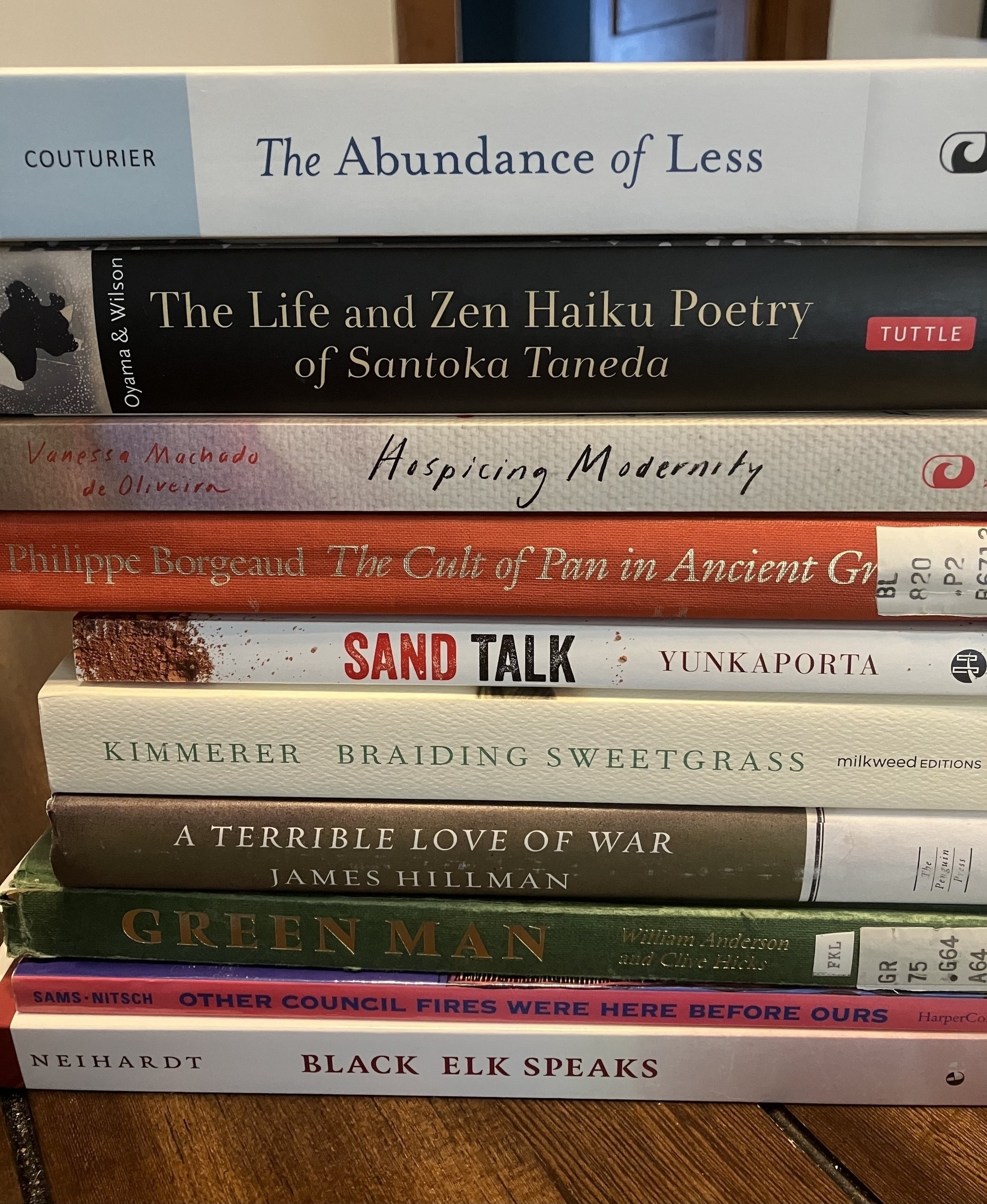
I’m so glad to have maintained a log of the books I’ve read since 2005. Not least because it’s such a window into the ways I’ve changed over the years. Anyway, I’ve created a page that lists the books in reverse chronological order. Some gaps are true gaps and some are just record-keeping failures.


Now moving on from a book about limits on tools to one about simpler living.

Cover of book titled The Abundance of Less with garden in the background.