Posts in: Wendell Berry

Wendell Berry, “It All Turns on Affection”:

For humans to have a responsible relationship to the world, they must imagine their places in it. To have a place, to live and belong to a place, to live from a place without destroying it, we must imagine it. By imagination we see it illuminated by its own unique character and by our love for it. By imagination we recognize with sympathy the fellow members, human and nonhuman, with whom we share our place. By that local experience we see the need to grant a sort of preemptive sympathy to all the fellow members, the neighbors, with whom we share the world. As imagination enables sympathy, sympathy enables affection. And in affection we find the possibility of a neighborly, kind, and conserving economy.


Wendell Berry, “Renewing Husbandry”:

I remember well a summer morning in about 1950 when my father sent a hired man with a McCormick High Gear No. 9 mowing machine and a team of mules to the field I was mowing with our nearly new Farmall A. That memory is a landmark in my mind and my history. I had been born into the way of farming represented by the mule team, and I loved it. I knew irresistibly that the mules were good ones. They were stepping along beautifully at a rate of speed in fact only a little slower than mine. But now I saw them suddenly from the vantage point of the tractor, and I remember how fiercely I resented their slowness. I saw them as “in my way.” For those who have had no similar experience, I was feeling exactly the outrage and the low-grade superiority of a hot-rodder caught behind an aged dawdler in urban traffic. It is undoubtedly significant that in the summer of 1950 I passed my sixteenth birthday and I became eligible to solve all my problems by driving an automobile.

Two things:

  1. When I drive I become a different person. I am normally a patient person—but not when I’m driving. I become aggressive. I call people assholes. I would never do that in person! (And not just because I wouldn’t want to get in a fight.) I offer this as a counterpoint to those who would suggest that our tools (using that word broadly) are morally neutral. They do, in fact, train us in certain ways of being.
  2. Berry’s story is another example of Illich’s ideas about the development of tools

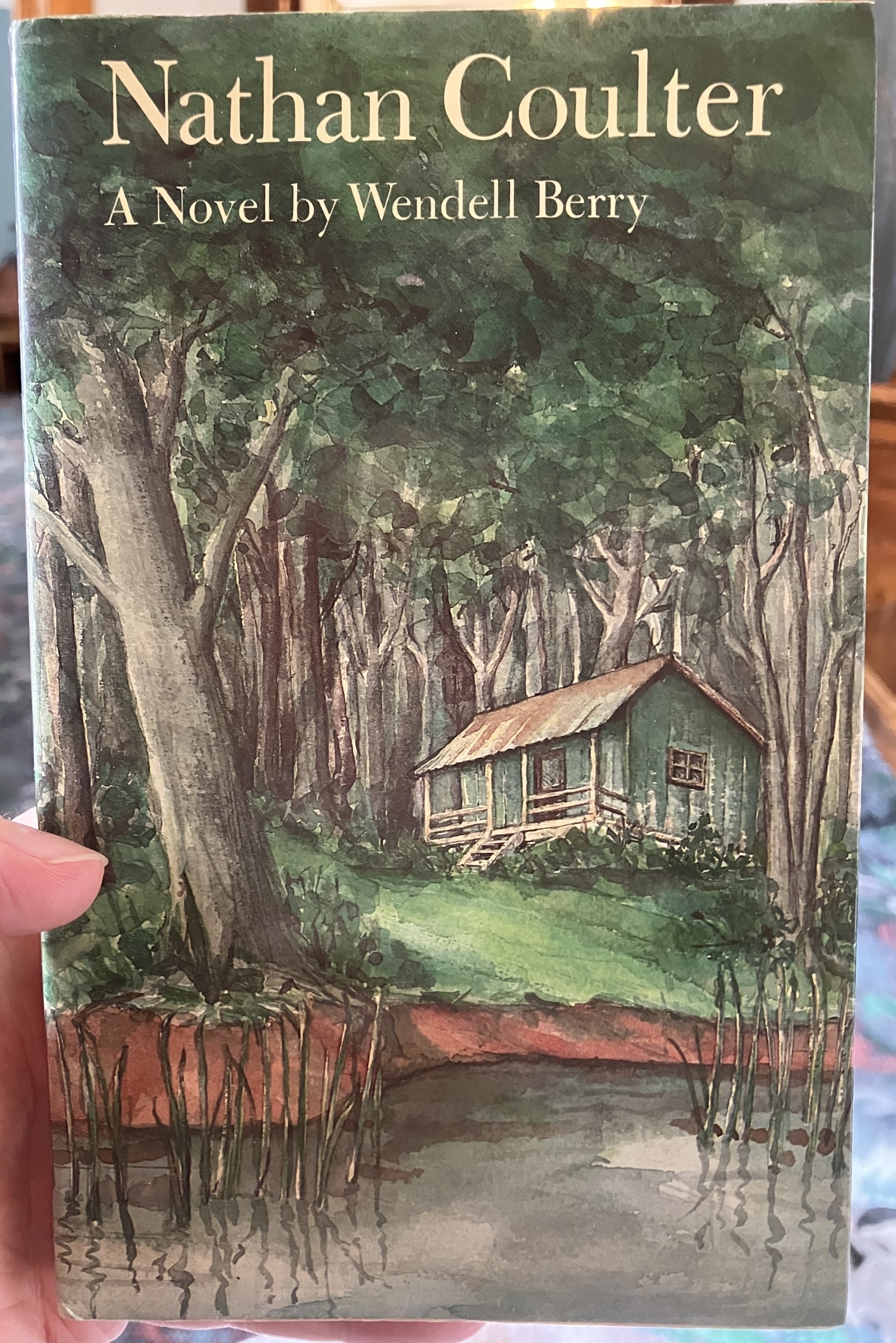
Finished reading Jayber Crow by Wendell Berry. Beautiful and heart-breaking. I think I’ll keep working my way through his fiction.


Wendell Berry, Jayber Crow (p248):

All I can answer is that I did love her all her life—from the time before I ever saw her, it seems, and until she died. I do love her all her life, and still, and always. That is my answer, but in fact love does not answer any argument. It answers all arguments, merely by turning away, leaving them to find what rest they can.

That’s certainly one of the most beautiful things you’ll read all week.


I’ve been an admirer of Wendell Berry for over twenty years now—but, weirdly, I’ve only ever read his essays and poetry. I finally picked up one of his novels, Jayber Crow, and it’s being narrated in my head in Uncle Wendell’s mournful baritone. It’s a lovely experience.


Wendell Berry: from saving the planet to local care

Wendell Berry, “Word and Flesh” in What Are People For?: The question that must be addressed, therefore, is not how to care for the planet, but how to care for each of the planet’s millions of human and natural neighborhoods, each of its millions of small pieces and parcels of land, each one of which is in some precious way different from all the others. Our understandable wish to preserve the planet must somehow be reduced to the scale of our competence—that is, to the wish to preserve all of its humble households and neighborhoods.

Continue reading →


Wendell Berry’s fateful decision

When reading books or watching documentaries about sustainable, regenerative practices, it is a matter of when, not if, a person will quote Wendell Berry. The impact he has had on the world is amazing. He has had obvious impact on the environmental movement and “back to the land” organic small farms. He was also highly influential on Michael Pollan and Alice Waters—who in turn have become enormously influential. Yet the Wendell Berry we admire might not have been.

Continue reading →


Wendell Berry, “Family Work”:

Children, no matter how nurtured at home, must be risked to the world. And parenthood is not an exact science, but a vexed privilege and a blessed trial, absolutely necessary, and not altogether possible.


“The Reassurer” by Wendell Berry

A people in the throes of national prosperity, who breathe poisoned air, drink poisoned water, eat poisoned food, who take poisoned medicines to heal them of the poisons that they breathe, drink, and eat, such a people crave the further poison of official reassurance. It is not logical, but it is understandable, perhaps, that they adore their President who tells them that all is well, all is better than ever. The President reassures the farmer and his wife who have exhausted their farm to pay for it, and have exhausted themselves to pay for it, and not have not paid for it, and have gone bankrupt for the sake of the free market, foreign trade, and the prosperity of corporations; he consoles the Navajos, who have been exiled from their place of exile, because the poor land contained something required for the national prosperity, after all; he consoles the young woman dying of cancer caused by a substance used in the normal course of national prosperity to make red apples redder; he consoles the couple in the Kentucky coalfields, who sit watching TV in their mobile home on the mud of the floor of a mined-out stripmine; from his smile they understand that the fortunate have a right to their fortunes, that the unfortunate have a right to their misfortunes, and that these are equal rights.

Continue reading →