Uncle Wendell was mentioned by a Budget scribe out of Missouri
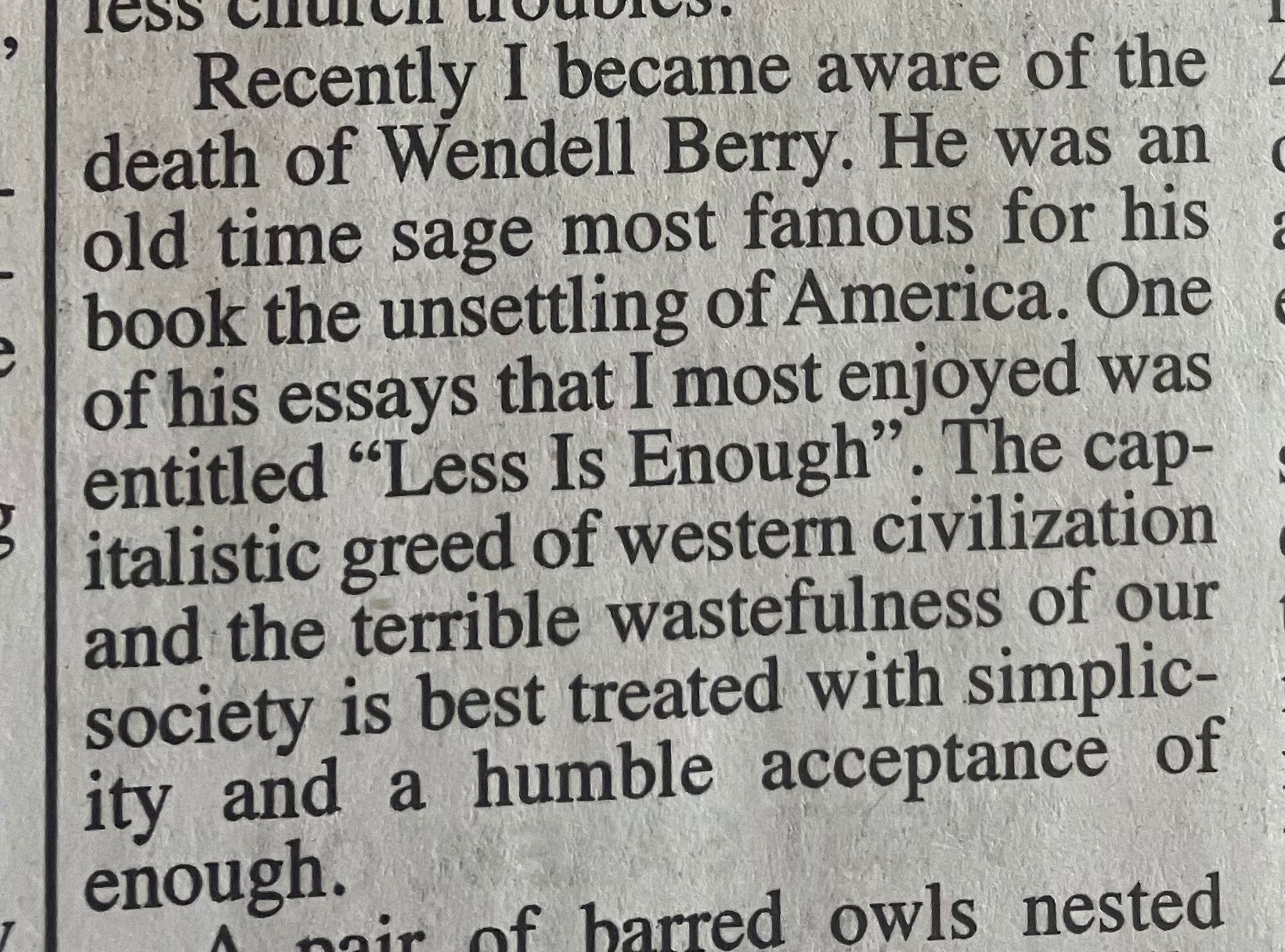
Uncle Wendell was mentioned by a Budget scribe out of Missouri
It’s here! Just in time for me to shape up a super secret project during my week off.

I took out a six-month subscription to The Budget, a weekly newspaper by and for plain Anabaptists (to quote the wiki). I probably won’t subscribe to it long term but I’m really interested in the scribe letters.
Sally Fallon Morell talking about scrapple, a breakfast food made from pork bits. I actually came across this at an Amish grocery store recently but couldn’t remember the name until I came across this article. Has anyone had it?
Rachel and I drove around the Amish settlement in Daviess County today and came across this guy spreading manure. (Poor quality, I know.) It was still cold today but the strong sunshine felt like a promise. After looking around the Odon Locker, we walked across the parking lot to a shop with a sign saying something about Amish goods, with the requisite buggy image. Turned out to be one of those faux Amish shops meant for tourists and church ladies.
Such is the centrifugal power of our economy that even the Amish are increasingly working away from home. Though it varies by settlement, generally less than half of Amish families farm full-time. Larger and larger numbers of Amish men are working in construction or in factories.
An insightful observation from Bernd G. Längin in Plain and Amish:
All these conservative Anabaptist groups, heirs of identical church reformers, represent something similar to the medieval monsastic system of the Catholic Church. Transplanted into colonial America, they have persevered in living a Protestant ascetic alternative—but without the vow of celibacy.
The Amish ordnung can be compared to a monastic rule of life. Incidentally, early Anabaptist Michael Sattler actually was a Benedictine.
When I’m looking through the library catalogue for books on the Amish, it’s very annoying to have to filter through all the bonnet rippers .
According to Steven Nolt in A History of the Amish, the split between the tradition-minded Old Order Amish and the change-minded Amish Mennonites happened around 1865, though gradually and not due to any single event. Among the Amish Mennonites there was a bishop named Henry Egly who had a powerful conversion experience during an illness in the 1840s. Whether the influence of American evangelicalism and revivalism on him came before or after this experience is not clear from the text.
In The Amish Way, the authors describe patience as one of the key characteristics of Amish life. The lessons of patience are built into the structures of their lives—even the church services are three hours long, with one twenty-minute hymn that always precedes the preaching. I will admit to a certain amount of anxiety as we await the huge snowstorm to hit here. We’ve lived through worse, to be sure. Last night we were remembering one storm that hit early in our marriage.